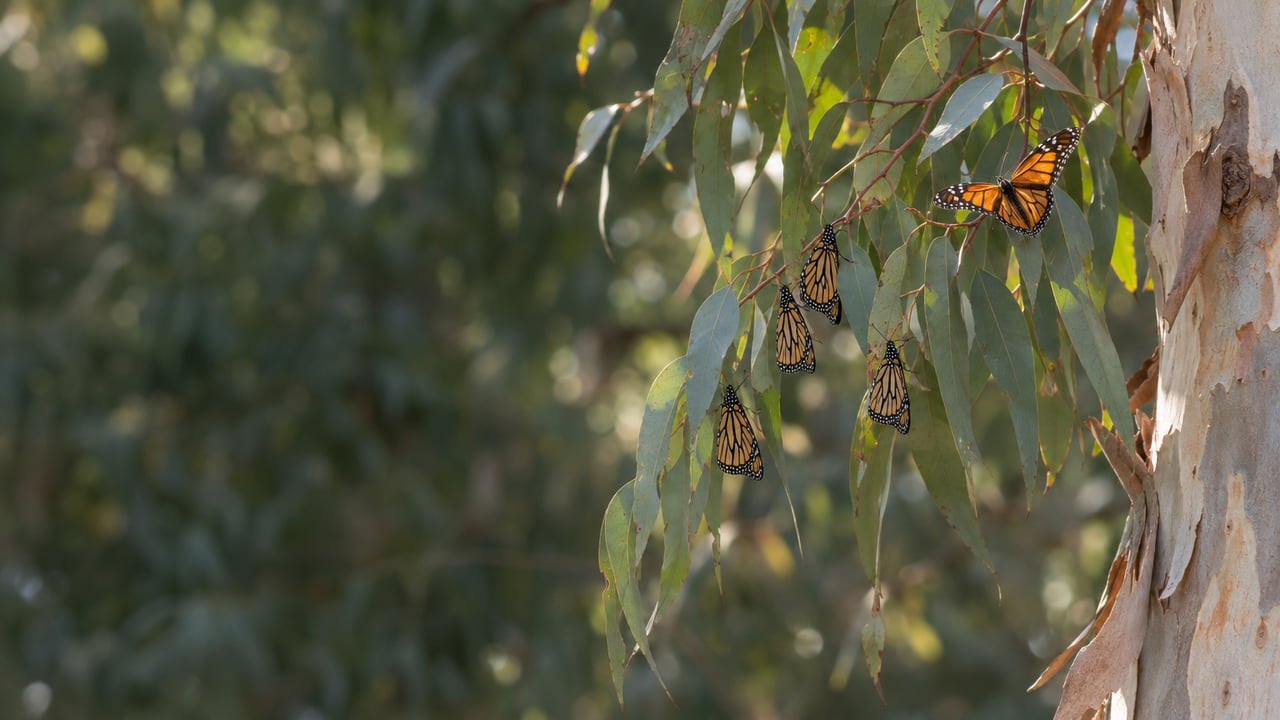
The Xerces Society's early-season Western Monarch Count ran from October 17 to November 1, 2026. Volunteers recorded nearly 5,000 monarchs at more than 190 overwintering sites along the California coast. Two of those sites are a short drive from downtown Santa Cruz. On October 30, Natural Bridges State Beach held 1,426 monarchs and Lighthouse Field State Beach held 421. Together that is 1,847 butterflies, more than a third of everything counted statewide during the survey window.
Xerces expects numbers to peak in mid-to-late November, and its mid-season count runs November 14 to December 6. Later in the winter, a super El Niño is projected to bring high winds and heavy rain to the coast. The best weeks of the season start this Saturday, and they land on the Westside and West Cliff.
| Grove | County | Early-season count, fall 2026 |
|---|---|---|
| Natural Bridges State Beach | Santa Cruz | 1,426 on Oct. 30 |
| Lighthouse Field State Beach | Santa Cruz | 421 on Oct. 30 |
| Pismo State Beach Monarch Sanctuary | San Luis Obispo | 365 on Oct. 27 |
| Monarch Bay Golf Course | Alameda | 253 on Oct. 20 |
| Harbour Boulevard | Ventura | 124 on Oct. 29 |
| Pacific Grove Monarch Butterfly Sanctuary | Monterey | 14 on Oct. 30 |
| Ellwood Mesa | Santa Barbara | 8 on Oct. 26 |
These figures come from the preliminary list Xerces sent on November 4. Verified results will be posted to WesternMonarchCount.org in January, and Xerces notes that counts may have risen in the days after each survey.
How a shrinking population ended up concentrated here
The leading share belongs to Santa Cruz because the overall population has collapsed. The City on a Hill Press reported on October 23 that western monarchs have declined by 99 percent since the 1980s. It also reported that the Western Monarch Count has recorded the five lowest totals in the past 10 years, and that Santa Cruz sites now lead the top counts as numbers have fallen.
Kirk Crane, a volunteer docent at Natural Bridges, described the earlier scale to KAZU in October:
"We had 120,000 in 1997. You'd go through that grove down there, and they would just be roped with huge clusters the size of you and me."
According to the City on a Hill Press, Natural Bridges has three rings of trees that block wind and bad weather. Their open centers let the monarchs reach sunlight to warm their wings. The eucalyptus there blooms in winter, when the butterflies need nectar most. Rhiannon Sims of the Santa Cruz District of California State Parks told KAZU that monarchs pick these sites partly for wind protection. As the statewide population shrinks, the remaining butterflies end up in the most sheltered groves, and two of those are inside Santa Cruz city limits.
Two groves, two different starts
Comparing this fall to last fall shows the two West Cliff-area groves heading in opposite directions so far:
- Natural Bridges had 1,100 monarchs as of October 29, 2025, and 1,426 on October 30, 2026.
- Lighthouse Field had 979 monarchs as of November 1, 2025, and 421 on October 30, 2026.
Statewide, Xerces calls the early numbers similar to last year, when the same survey period found 6,113 monarchs at 218 sites. Last winter offers a rough guide to how the next few weeks could go. Natural Bridges peaked at about 2,500 monarchs in early December 2025, during a mid-season count that totaled about 12,260 statewide across 249 sites. Xerces reported that total as the third-lowest since counting began in 1997. By the late-season count, Natural Bridges was down to 1,540, Lighthouse Field had 804 and Moran Lake had 520, out of 6,464 counted statewide at 193 sites.
If this season follows that pattern, the biggest clusters at Natural Bridges will form between now and early December, and numbers will drop after the holidays.
Why the next three weeks matter more than usual
When monarchs first arrive, they fly around and feed on as much nectar as they can before settling in. Clustering comes later. Lily Aravanis, a field interpreter at Natural Bridges, told the City on a Hill Press that later in the season the park will have "hundreds, hopefully thousands of butterflies that cluster in the trees," all holding onto the same branch. Xerces says cooling temperatures and rainfall bring on the mid-to-late November peak.
This winter, the weather that brings the clusters together could also break them up. Xerces says severe storms can split clusters, knock butterflies to the ground and drain their energy reserves. The organization says it is "deeply concerned this winter could cause significant habitat damage and drive up monarch mortality." Sims made the same point to KAZU: "if we have a big storm that comes through, sometimes even being in the grove isn't enough to protect them." The Santa Cruz Sentinel reported on October 20 that the National Weather Service expects a very strong El Niño event, and that El Niño does not guarantee any particular local impact.
Late November and the first week of December are when the clusters should be largest, and that period comes before the stormier second half of the season Xerces expects.
Where to see them, grove by grove
Natural Bridges State Beach, Westside. This is the grove with the most to see and the most support for visitors. A wheelchair- and stroller-accessible boardwalk leads to an observation deck inside the grove. The park is open 8 a.m. to sunset. From October 1 through January 31, the visitor center is open daily from 11 a.m. to 4 p.m. Vehicle day use costs $10. California State Parks says volunteer docents are in the grove daily from 11 a.m. to 4 p.m. from mid-October through December. It recommends calling the park for current butterfly numbers and docent availability before you go.
Lighthouse Field State Beach, West Cliff Drive. This is the closer option for anyone downtown or on the West Cliff side, and the one that works for a dog walk. State Parks lists park hours of 6 a.m. to sunset and parking-lot hours of 8 a.m. to sunset. Leashed dogs are allowed, including on the beach. Leashes can be no longer than six feet, and dogs can't be left unattended. In the park's 2017 monarch site management plan, the recurring cluster was in the central tree grove, mostly on mid-story Monterey cypress surrounded by eucalyptus and cypress.
Moran Lake County Park, East Cliff Drive in Live Oak. The third local grove is at 22775 E Cliff Dr. The park is open sunrise to sunset and has a parking lot with ADA spaces, restrooms, a multi-use trail and monarch butterfly habitat. According to the county's habitat plan, the main eucalyptus grove surrounds the D.A. Porath sanitation facility off Lode Street, and there are more overwintering trees inside the park. The grove has changed recently. Santa Cruz County Parks trimmed trees on the lake's north and west banks and removed the remaining eucalyptus at 40 Moran Way in summer 2025, then regraded that parcel in the fall. The county plans to replant 40 Moran Way with native trees and shrubs this fall and winter once the rains begin. Moran Lake had 520 monarchs in last winter's late-season count.
All three groves are on the same coastline. On a calm, sunny afternoon you can visit Natural Bridges while docents are there, then see Lighthouse Field and Moran Lake on the way back across town. Bright, sheltered days are when clustered monarchs open their wings to warm up, so they are the best days to plan around.
Counting, not just watching
The mid-season survey that starts Saturday used to be called the Thanksgiving count. Xerces asks new and returning volunteers to register every year through WesternMonarchCount.org. KAZU listed citizen science alongside protecting habitat and cutting out pesticides as good places to start helping monarchs. The late-season survey runs December 26, 2026, through January 10, 2027, so there is a second chance to count after the holidays, though the butterflies may have been through some storms by then.
Stacey has lived in Santa Cruz for more than 25 years, and the West Cliff groves are among the places she points visiting friends and family to every November. If a walk through Natural Bridges or Lighthouse Field gets you thinking about where in Santa Cruz County you'd like to spend your weekends, or how your current home fits the life you have here, Stacey Mitchell is happy to talk it through. Let's Connect.